 Sign in with Steam
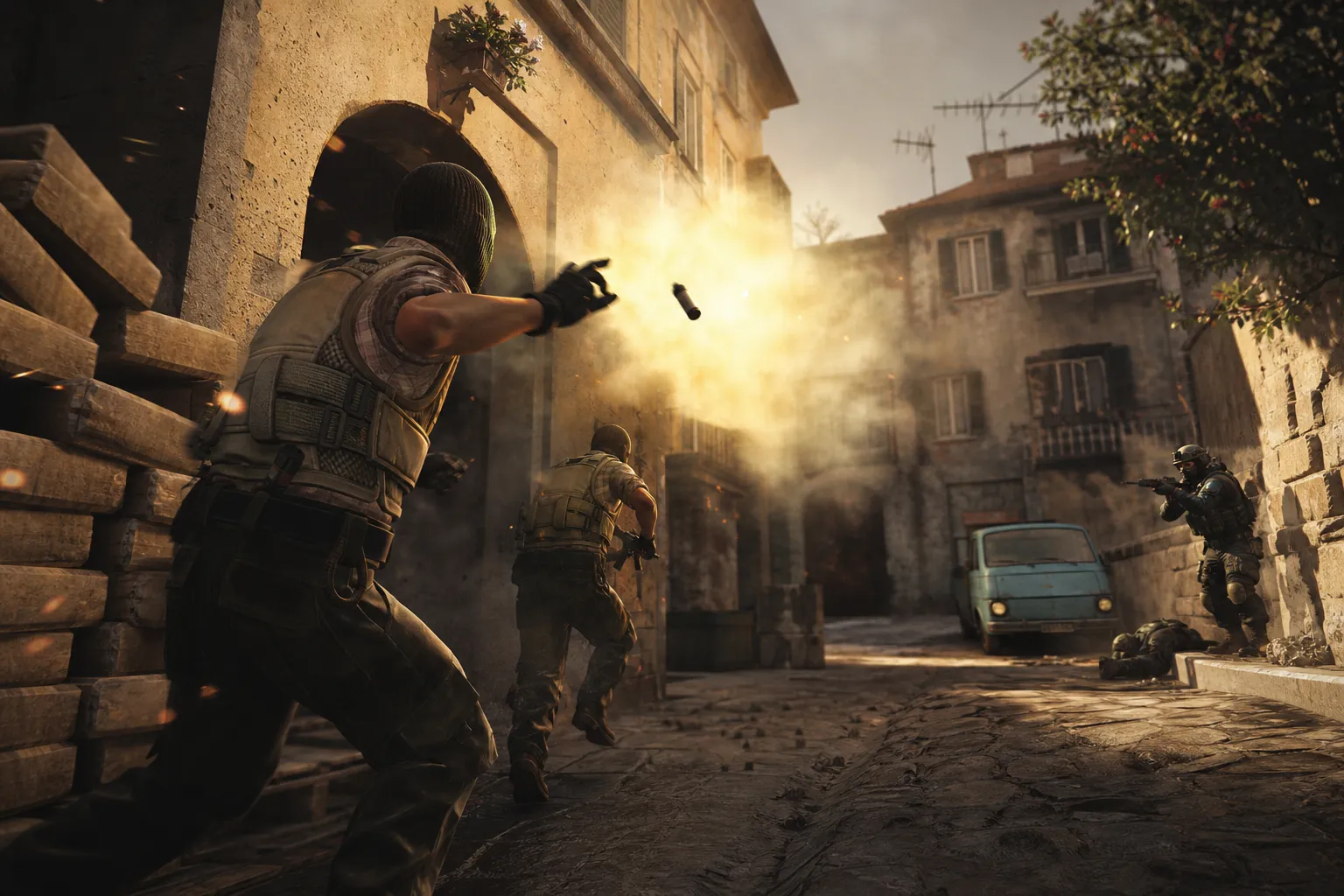
You know the round. CTs have one smoke, a flash, and a man swinging Banana like he owns the place. Your entry guy takes two steps too late, gets deleted by a guy hugging coffins, and suddenly your whole T side feels cooked before the first 20 seconds are done. Inferno Banana isn’t just a lane — it’s a timing test, and the difference between a clean T round and a free frag is usually about 1.5 seconds.
Banana is where bad T sides go to donate rifles
Inferno looks simple until you actually try to take Banana in a real match. Source 2 didn’t change the fact that if you arrive late, CT utility is already set, the angle is already held, and you’re walking into a crossfire with a FAMAS or M4 waiting for your forehead. On 64-tick Premier servers with subtick, the movement feels crisp, but the timing punishments are still brutal — if you miss the window, you’re not “playing slow,” you’re letting the CTs farm money.
And Banana is expensive. One lost rifle swing can snowball into a full CT setup, which is why the first 20–30 seconds matter so much. If you’re playing T side and your banana pressure is lazy, you’re basically telling the defenders they can save utility for later and still keep control of the round. That’s how teams get locked out of B, over and over.
The first 8 seconds: don’t fake pressure, actually take space
The opening Banana timing is the first split. Not later. Right off spawn, the T side should already know whether they’re fighting for early space or giving it up for a default. If your first guy reaches half-wall and nobody is ready to trade, that’s not a timing issue anymore — that’s a setup issue.
What good teams do here is boring, which is exactly why it works. One player jiggles logs, one clears close right, and the third is ready to punish the CT who wants to swing off a flash from car. You’re not trying to win the whole map in 5 seconds. You’re trying to make the CT respect your presence so they can’t just get cute with a peek.
What the first wave should look like
- Spawn movement is instant. No shoulder-checking the floor like you’re on a sightseeing tour.
- One player takes the contact duel near logs.
- One player supports with a flash for the swing.
- The third is watching for the aggressive CT push from car or half-wall.
If you hit Banana late, you’re usually walking into a stacked CT economy round where they’ve bought a $200 HE, a flash, and maybe a smoke. That’s not a lot of money, but it’s enough to ruin your pace if you’re sloppy. Good T teams make the CT spend it early and badly.
At 0:20 to 0:35, the real Banana timing shows up
This is the timing that separates the average stack from the round-winning one. Around the 20- to 35-second mark, the CTs usually decide whether they’re contesting Banana again or falling back to preserve utility for the execute. That decision point is where you want to be ready, not still rotating your second guy from mid like it’s a PUG on Mirage.
There’s a massive difference between “taking Banana” and “owning the space after the CT nade dump.” If you force out their HE and both flashes, your next move matters. You either keep the pace and squeeze them off the angle, or you let them reset for free and now they’ve got coffins, car, and newBox all wired together. That’s how you get stalled for 45 seconds and end up praying for a B split that’s already dead.
This is where pro teams are miles ahead of regular lobbies. Watch how FaZe or Vitality play Banana in a Major playoff match and you’ll see the same pattern: fight early, soak damage, reset, then re-hit once the CT utility is gone. ZywOo doesn’t need some mystical aim buff there — he just benefits from his team knowing exactly when the next T body should appear on Banana.
The 40-second mark: when bad Ts overpeek and good Ts freeze the CTs
By the 40-second point, the CT side starts feeling pressure if you’ve shown enough presence. This is the timing where a lot of T sides get greedy. They think, “We’ve had Banana for a bit, let’s peek for info,” and then boom — one dry swing into a pre-aimed M4, and your round loses its shape.
Don’t do that. Really. The better play is often to hold the space and force the CTs to guess. If they’ve already spent a smoke on top Banana or a molly for logs, they’re now deciding whether to re-fight with a half-buy of utility or just give you the lane. That hesitation is valuable. Use it.
Here’s the part people miss: timing isn’t only about speed. It’s about arriving when the CTs are in an awkward money spot. A team on $2,250–$3,000 per player can buy a mixed set of nades, but they usually can’t afford to repeat that every round. So if you keep showing Banana at the same intervals, you’re chewing through their bank and making the B site weaker on the next buy round. That’s real economy pressure, not just “map control.”
The 55-second read: commit, split, or stop pretending
Once you’re around the 55-second point, the Banana timing becomes a decision tree. If you’ve got control, great — commit to the B hit. If you’ve lost it, maybe you split through mid or fake pressure and go A. What you should not do is stand around with two players in Banana, one in mid, and one outside apps like you’re waiting for the map to tell you what to do. That’s how you throw rounds against competent CTs.
Good T teams use this timing to force a reaction. The CTs have to show whether they’re leaning banana, cheating rotator, or holding passive. On Inferno, that information matters because the A hit is so slow to recover from if you waste 20 seconds on Banana for no reason. This is also why teams like Heroic and G2 have looked so clean on Inferno when their spacing is sharp — the round plan isn’t just “go B,” it’s “make the CTs wrong at exactly the moment they can’t afford it.”
And yes, the subtick system in CS2 makes the gunfight feel more honest in some spots, but it doesn’t rescue poor timing. A late swing is still a late swing. A half-baked flash is still a half-baked flash. Donk can bully a lane because he’s absurd, but most of us aren’t donk, and pretending otherwise is how you end up spectating from spectator cam after 18 seconds.
Simple fixes that stop Banana from becoming a donation box
If your T side Banana play keeps dying for no reason, tighten the routine. No fancy theory. Just actual discipline.
- Leave spawn together.
- Use the first flash before the CT can comfortably spam or swing.
- Re-clear logs after the first utility exchange.
- Don’t overpeek after gaining space — that’s usually the throw.
- Call the 35- and 55-second marks out loud so your team stops freelancing.
One more thing: if you’re buying a weird half-utility setup and hoping to out-aim everyone, stop. On T side Inferno, Banana pressure is a team job. A $300 flash and a properly timed Molotov do more work than a hero rifle taking a vanity duel against a CT with full info. CS Rating and Premier grind players love to talk about mechanics, but mechanics don’t matter if you’re arriving to the lane after the CTs have already built a little fortress out of smoke and confidence.
Banana timing is one of those old-school Inferno skills that still wins rounds in CS2, and probably always will. If your team can hit the lane on time, reset cleanly, and make the CTs guess wrong at 20, 40, and 55 seconds, you’ll feel the round tilt in your favor before anyone’s even crossed Second Mid. So ask yourself next time you spawn in: are you taking Banana, or are you just walking toward it and hoping the enemy plays nice?