 Sign in with Steam
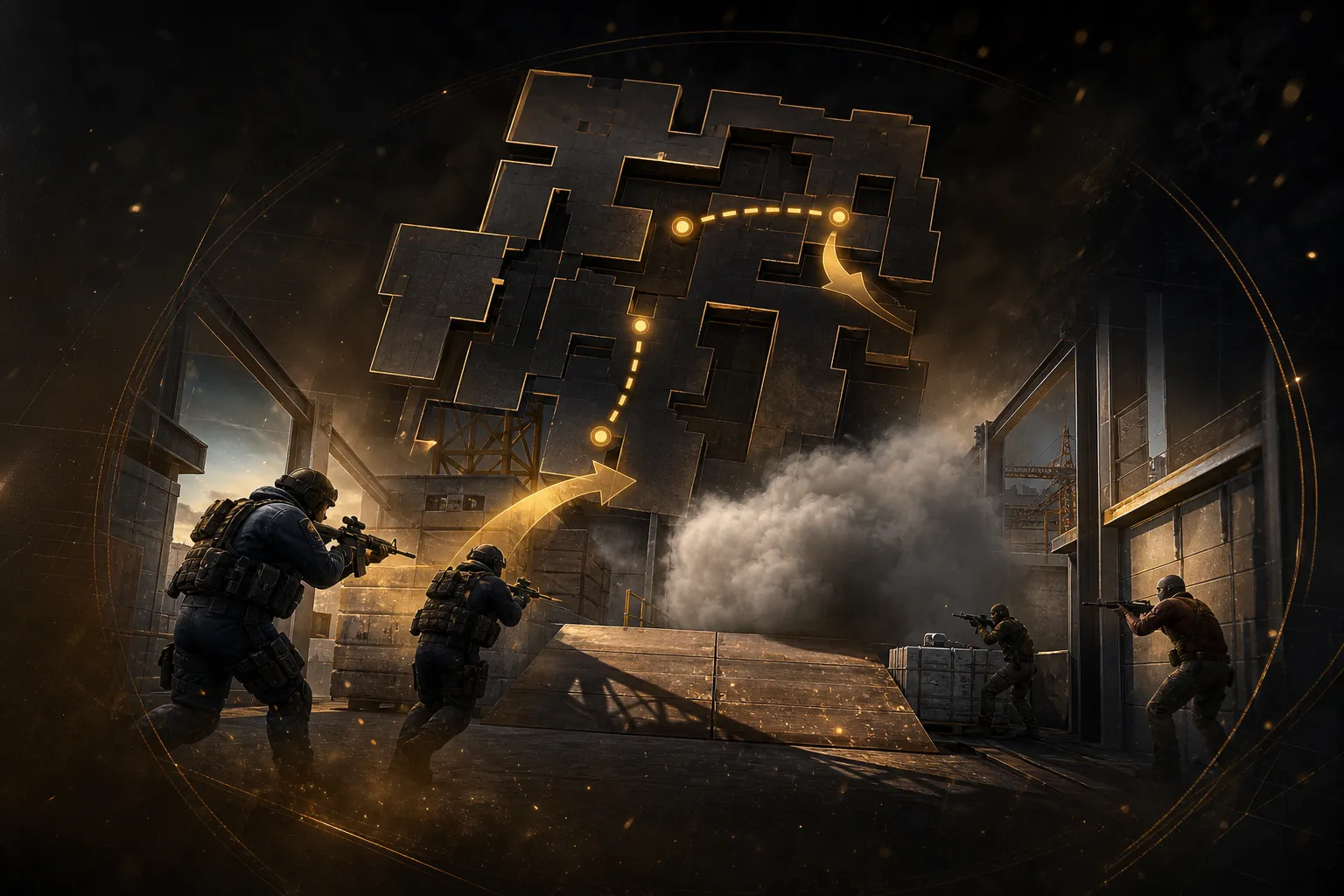
You know the feeling: you’re holding B site on Vertigo, the smoke blooms on the ramp, and by the time your brain says “rotate,” the CTs are already in the vent, under ladder, or somehow walking out from A lobby like they paid rent there. Vertigo punishes slow reads harder than almost any map in CS2. In a Source 2 game with subtick, that tiny half-second gap between the first contact and the smoke landing is basically the whole round.
The best CTs don’t wait for visual confirmation. They read the round shape before the utility even lands. That’s the difference between a clean 3v3 retake and getting farmed by a five-man hit while your rotator is still stuck deciding whether the fake was real.
Vertigo gives you way more info than people think
Vertigo is a weird map in the best and worst ways. The verticality makes sound matter a ton, but it also means players tunnel vision on the wrong layer of the map. A guy holding A ramp hears footsteps? Great. The real question is whether those footsteps are enough to justify pulling a second defender before the smoke even pops.
CT rotations on Vertigo start with recognizing which fights are expensive for T side and which ones are cheap. If they’re using full ramp smoke, molotov, and flash into A every round, that’s usually a real hit. If it’s just one contact at ramp and a late jiggle at mid, you’re probably looking at a probe, not a commit.
The map also gives you some classic tells:
- Ramp pressure plus early utility usually means A is the main plan.
- Mid presence is often there to split A or punish a solo rotator.
- B contact is slower, uglier, and more common when T side wants to drag your A anchor out of position.
- If nobody contests ladder room by the 1:15 mark, expect a mid-to-A or fake-heavy round.
Read the utility, not just the footsteps
Most players overrate sound cues and underrate smoke timing. On Vertigo, the smoke timing is the real script. A standard T-side hit with a 13,000 starting economy in Premier can afford layered utility, and that matters because the money tells you what kind of round they’re trying to buy. If you hear two smokes and a molly early, that’s not random spam — that’s a team making space for a real execute.
CTs should be asking a simple question: did they spend utility to take space, or did they spend utility to hide information? If the answer is the second one, your rotation needs to be slower and more surgical. Don’t yank the B anchor off site because a single flash popped at mid. That’s how you hand over free plants on a map where post-plant angles are already annoying enough.
What the smoke timing usually means
- Smoke lands before 1:05: likely a fast exec or a contact play with support behind it.
- Smoke lands around 0:50 to 0:40: fake pressure, delayed split, or a mid-round call built off CT movement.
- Smoke lands after 0:35: either desperation, or they’re waiting for your rotator to overextend.
That last one gets people all the time. You see nothing, you move, and the T side suddenly has the exact info they wanted. Classic Vertigo nonsense.
Where your eyes should be: A ramp, mid, and the dead zones
A lot of players stare at the obvious choke and miss the weird little spaces where good teams actually create the round. On Vertigo, the “dead zones” are often more important than the contact point. If your A anchor is alive but blind, and your mid player is tucked behind cover with no info, you’re already in a guessing game.
For CT rotations, the key spots are pretty simple:
- A ramp — obvious, but don’t overreact to every footstep.
- Mid — this is your warning system for splits.
- B stairs and the lower B approach — if these go quiet too long, something’s up.
- Connector-style lanes between zones — the moment these are smoked, your response has to be based on timing, not hope.
Pros like ZywOo and m0NESY are nasty at using tiny gaps in information, and that same idea applies to CT rotations. You don’t need a miracle read. You need a decent one, made early. Even donk-style pace, when it shows up in pro play, looks terrifying because teams are late by just one piece of information. That’s all it takes.
Stop rotating like you’re reacting to a clip
Too many CTs rotate when the round is already solved. They hear one sound, panic, and sprint. That works in Faceit level 7 chaos sometimes, sure, but in real rounds it just opens the map. Vertigo rewards the team that keeps one defender anchored, one player flexible, and one rotator who can read the round without turning into a third body on the wrong site.
A clean CT setup usually looks something like this:
- One hard anchor on the likely hit site.
- One player with a fast but controlled rotation route.
- One lurk-denial player who can punish mid or ladder pressure.
- One player ready to stack only after real info, not vibes.
That middle player is the difference-maker. If you’re rotating from A to B, don’t take the longest, loudest path unless the round is already screaming B. On Vertigo, a rotation that saves 4 seconds is massive. Four seconds is enough for a flash-through, a late lurk, or a T-side swing that turns your “help” into a 2v4.
And yeah, this is exactly the kind of detail teams at Major level abuse. Watch any deep run from a squad like Vitality or NAVI in a big event and you’ll see the same thing: CTs aren’t just rotating on contact. They’re rotating on likely contact, then braking if the info doesn’t fully add up.
The economy tells on the round
If you want to read Vertigo rotations earlier, stop ignoring money. A T-side with $2,400 per player after a plant can still threaten a half-buy punch, but the shape of the round changes if they’re on AKs, two Galils, and a couple of flashes versus a full set of rifles and nades. You don’t need a spreadsheet. You just need to know what their buy probably looks like.
Here’s the simple version:
- Full rifle rounds usually come with layered pressure and a real split.
- Anti-eco rounds often fake contact, then explode late on the weaker site.
- Low-buy rounds tend to stack numbers behind one piece of utility and pray you overrotate.
So if you’re CT and you hear a weak opening, don’t throw the whole defense away. One of the dumbest habits in CS2 is turning a maybe-round into a guaranteed loss because someone got impatient. Keep the shape of the defense intact until the smoke, flash, or audio confirms the hit. Not before.
How to build the read before the smoke pops
The actual skill here is pattern recognition. After enough Vertigo games, you start noticing tiny repeats: the same spawn routes, the same early molly for ramp, the same mid contact timing, the same fake flash that always comes right before the real hit. That’s not magic. It’s just reps.
Try this in your next games:
- Count the utility, not just the bodies.
- Track whether they’re showing mid before committing elsewhere.
- Notice if the same player keeps being first into space — that’s often the caller’s tempo guy.
- Keep one eye on the clock. A late smoke at 0:40 means something very different from a 1:10 pop.
If you’re reviewing your own demos, pay attention to the first 15 seconds of each round. That’s where the real tells are. Not the last two kills. Not the flashy retake. The boring part where the round quietly becomes obvious if you’re watching it properly.
That’s Vertigo CT play in a nutshell: don’t rotate because the smoke landed. Rotate because the round was already telling you it would land there five seconds earlier. Are you actually reading the map, or just chasing the sound cue after it’s too late?